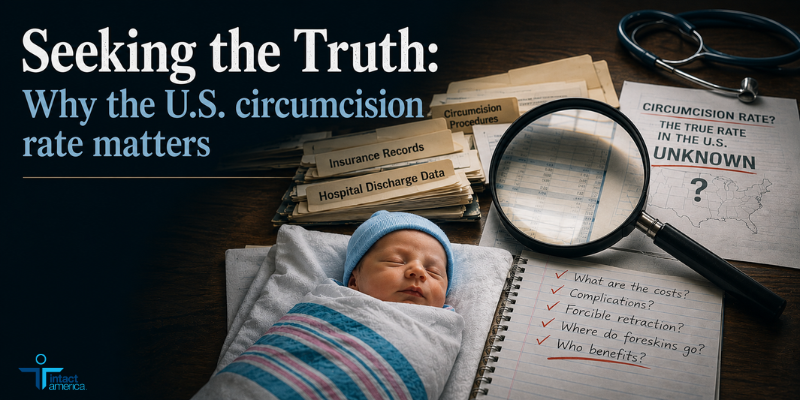
One of the most frequent inquiries posed by journalists, ethicists, doctors from other countries, and our constituents continues to be: What is the true “rate” of infant circumcision? Meaning: what percentage of newborn baby boys are subjected to the forced removal of their penile foreskins?
Most people, understandably, aren’t pleased to hear the response: “Nobody really knows.” They don’t have the patience to hear about the complexities of medical data collection, and how uninclined the medical establishment is to pull back the curtain on a “procedure” that—in actuality—constitutes an unethical and brutal mutilation of a child who cannot consent.
“Nobody wants to talk about it.”
Well, WE DO, and WE KNOW YOU DO, TOO!
The current survey (launching in Summer 2026) will determine the true rate of infant genital cutting by going to the ONLY direct source of information on the topic—mothers of baby boys. Mothers are the ones solicited or pressured to “consent” (see Intact America’s 2020 survey on this topic), mothers take the babies home and care for them; mothers generally oversee the medical care for their children; mothers know whether their babies are well or distressed… In short, mothers are the best—indeed, the only reliable —informants regarding whether their baby sons have been subjected to the removal of their foreskins.
In 2025, a short note in JAMA Pediatrics by researchers from Johns Hopkins University reported that for the first time in decades the rate of neonatal circumcision fell to its lowest level in many decades, somewhere between 49 and 54%. Many intactivists were pleased, believing this means that our message is being received by the public, by expectant parents—even by doctors—and that due to our advocacy, more babies are being spared.
But there is reason to be skeptical about the authors’ claims. The only source for the figures presented was insurance records for circumcisions carried out between a baby’s birth and his discharge from the neonatal hospital stay (generally one to three days). We know from many sources—mostly still anecdotal—that circumcision practice patterns are changing rapidly, that they vary widely among hospitals and geographically, and that nobody tracks whether babies not cut in hospitals are being cut elsewhere—in doctors’ offices, clinics, and other outpatient settings—during the 30-day window when most insurance will still pay. We also know that circumcisions paid in cash by parents do not turn up in insurance records and, thus, are not reported anywhere.
Why does this uncertainty matter? Well, the entire enterprise of infant circumcision falls into a realm of “banished knowledge”—a term coined by the late author, psychoanalyst, and philosopher Alice Miller (1923-2010) to describe the purposeful suppression by perpetrators of pervasive child abuse (including circumcision) in our culture. This means that not only does the practice take place behind closed doors, but that the details of the practice (the pain, the bleeding—indeed, all knowledge and acknowledgment of the body part being removed) are unrevealed, unrecognized, subjects of secrecy and shame.
Back to the 2025 article, a closer look at the authors’ backgrounds and affiliation reveals a longstanding pro-circumcision bias, characterized by false claims about the procedure’s medical benefits and—significantly—alarmist warnings that a decrease in circumcisions in the United States will result in an explosion in subsequent medical costs. The hidden agenda, then, of this “fact”-based paper on falling neonatal circumcision rates was to bolster the continuity of infant male genital cutting.
Naturally, the perpetrators of infant circumcision have ignored a host of issues and questions that one would hope they would have addressed:
- What ARE the costs of circumcision?
- How common are complications (and what is their cost over the lifetime of men who were cut as babies)?
- What is the cost of damage created by forcible foreskin retraction? (An Intact America survey conducted in 2018 found that 43% of intact boys had their foreskins forcibly retracted during their first five years of life by medical personnel or caregivers who had been instructed to do so by medical personnel.)
- What happens to the foreskins?
Only by knowing the true extent of this practice—including efforts of the medical industry to hide it from view, to suppress knowledge about the natural male genitals, to instill fear into parents who might want to keep their boys intact, to ensure an ongoing revenue stream, to minimize physician and institutional liability, to ensure an ongoing supply of intact foreskins for “research” and commerce)—only by understanding all this can intactivists develop long-term strategies to bring the male foreskin into 21st Century North America. Only by knowing this can we increase the “presence” of the foreskin in popular discourse, as well as in academia (especially law and bioethics, medical and nursing education).






Wallace
September 19, 2026 1:05 pmTwo months prior to my seventh birthday I was made aware that I had been given a circumcision shortly after my birth in 1941. I had grown to so hate the naked glans sensation that in 1984 I began stretching my foreskin’s stump. In late 1999, I noticed that this activity had triggered the formation of a “phimosis ring.” A phimo-ring is a relentlessly contracting, inelastic, narrow cord of tissue situated between the inner and outer foreskin layers. It is NOT stretchable. I was last able to pass the phimo-ring over my glans corona some five, six years ago. Today, my preputial orifice (foreskin opening) is roughly the same diameter as my meatus [the slight depression encircling my urinary track opening (piss slit). I’m no longer able to retract my foreskin and remain fully covered at all times. Glans sensitivity has increased to such a degree that I have come to prefer being fully covered at all times. When young, I envied intact guys their tight foreskins never imagining that I would some day sport one myself! I’ve no interest in a re-circumcision or being retractile again.